
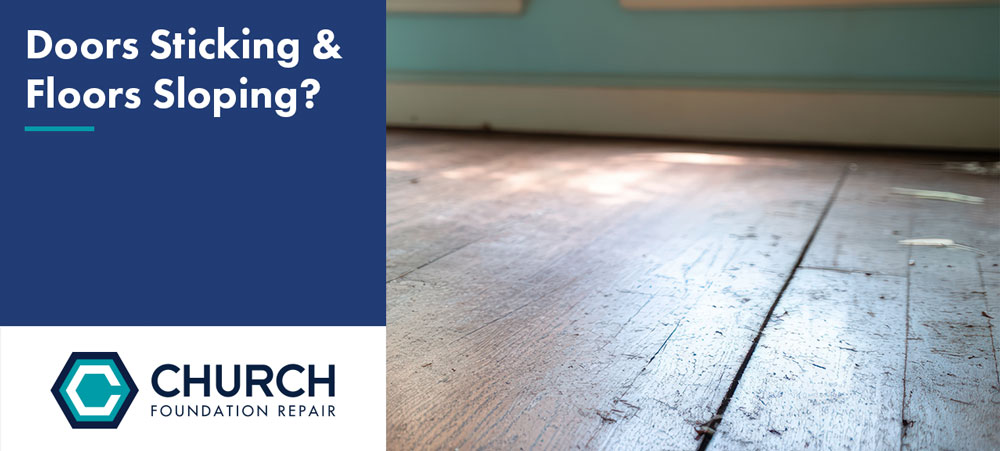
A door that suddenly will not close all the way. A floor that feels subtly off when you walk across it. These everyday annoyances are easy to dismiss as settling or humidity. In Central Texas, however, they are two of the most reliable early indicators of foundation movement.
For homeowners in Houston, Dallas/Fort Worth, and Austin, catching foundation problems early is the difference between a manageable repair and a major structural project.
Why Doors Stick When Foundations Move
Your door frames are attached to your home’s structure. When a slab shifts or settles unevenly, the frame shifts with it. A door that fit perfectly when the home was built starts to bind at the top or drag at the bottom because the opening itself is no longer square. This is called racking, and it is a textbook sign of differential foundation movement.
In Houston, where expansive clay soil can move several inches over a season, racking can develop quickly, sometimes within weeks of a drought or heavy rain event.
What Sloping Floors Tell You
Sloping or bouncy floors indicate that the slab beneath them has dropped in one area relative to another. This uneven settlement is caused by inconsistent soil support, which is particularly common in Houston neighborhoods built on heavy clay or filled land. You may notice the slope most clearly when rolling a ball across the room or setting a round object on the floor.
Other Symptoms That Often Appear Together
Doors and floors rarely tell the whole story alone. Look for these accompanying signs:
- Diagonal cracks at the corners of windows and door frames
- Gaps opening between the baseboard and the floor
- Cracks in tile or grout lines, particularly running in a pattern
- Wall cracks near corners where walls meet the ceiling
- Exterior brick showing stair-step or horizontal cracking
What to Do Next
If you are seeing one or more of these signs in your Austin, Houston, or Dallas/Fort Worth home, the most important step is a professional floor elevation survey. This is not a general walkthrough. A qualified foundation specialist uses precision equipment to measure the height of your slab at multiple points, creating a map that shows exactly where movement has occurred and by how much.
That data drives the repair recommendation. Without it, any estimate is a guess. Church Foundation Repair provides this kind of precision evaluation as part of every free inspection we conduct in Central Texas.
Schedule a Free Foundation Inspection in Houston, Dallas/FW, and Austin