
Most Central Texas homeowners think of foundation problems and plumbing problems as separate issues. They’re not. A slow sewer or water line leak beneath your slab can quietly erode the soil that supports your entire home — and by the time cracks appear in your walls, the damage is already well underway. Understanding the connection between under slab leaks and foundation movement is the first step to protecting your home.
Suspect a Slab Leak? Schedule Your Under Slab Leak Assessment Today
How Sewer Leaks Wash Out Soil Beneath Your Slab
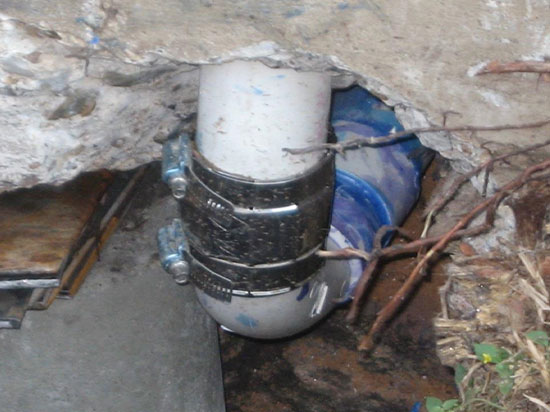
When a sewer line beneath your slab cracks or separates — whether from age, root intrusion, or ground movement — wastewater begins escaping into the surrounding soil. Over time, this constant moisture softens and erodes the clay and sand that your foundation relies on for support. The result is voids: empty spaces under the slab where solid ground used to be.
In central Texas’s expansive clay soil, this process is especially destructive. Water-saturated clay loses much of its load-bearing capacity. As sections of soil wash away or shift, the slab above loses support unevenly — leading to differential settlement, cracking, and structural movement that worsens with every rain cycle.
Warning: A slab leak doesn’t have to be dramatic to cause serious damage. Even a slow, persistent drip can erode enough soil over 12–18 months to cause significant foundation movement.
Signs You May Have an Under Slab Leak
Under slab leaks are often invisible until the damage is advanced. Watch for these indicators:
- Unexplained increases in your water or sewer bill
- Warm or damp spots on your floor with no obvious source
- The sound of running water when all fixtures are off
- Cracks in your slab, walls, or tile that appear suddenly or worsen quickly
- Soft, wet, or sunken areas in your yard with no rain explanation
- Persistent musty odors inside the home — especially near floors
Foundation symptoms — sticking doors, sloping floors, wall cracks — that appear alongside any of the above should be treated as a plumbing-and-foundation issue until proven otherwise.
How Under Slab Leak Detection Works
Modern leak detection is non-invasive and highly accurate. A trained technician uses a combination of methods to pinpoint the exact location of a leak without tearing up your floor:
- Pressure testing — isolating sections of pipe to identify pressure loss
- Video camera inspection — running a camera directly through the sewer line to visually confirm cracks, separations, or root intrusion
Accurate leak location is critical before any repair begins. Guesswork leads to unnecessary concrete cutting and incomplete fixes. A professional under slab leak assessment in Texas gives you a precise diagnosis — and a clear repair plan.
Related Services: Sewer Line Repair | Drainage Services | Slab Foundation Repair
Repair Options for Under Slab Leaks
Once the leak is located, repair options depend on the pipe type, location, and extent of damage:
- Spot repair — direct access through a targeted slab cut to fix a single failure point; cost-effective for isolated leaks
- Pipe rerouting — running new lines through interior walls or attic space, bypassing the damaged section entirely; ideal for older clay or cast iron pipe systems
For older Texas homes with original cast iron sewer lines — common in many inner-loop neighborhoods — a full under slab reroute is often the most reliable long-term solution. Your technician will recommend the approach that balances cost, disruption, and durability.
Combining Plumbing and Foundation Repair
If a leak has already caused soil erosion and foundation movement, fixing the pipe alone is not enough. The voids beneath your slab must also be addressed — otherwise the foundation will continue to settle even after the water source is eliminated.
The most effective approach is to coordinate plumbing repair and foundation stabilization as a single project. This means sealing or rerouting the leaking line, then using polyurethane foam injection to fill voids and restore support to settled sections with minimal excavation.
Working with a contractor who handles both disciplines — or who coordinates closely with a trusted plumbing partner — ensures that the root cause and the structural consequence are resolved together, not in isolation.
Pro Tip: Always repair the plumbing leak before or alongside the foundation work. Stabilizing a foundation over an active leak is a temporary fix at best.
Don’t Wait on a Suspected Slab Leak
Under slab leaks are one of the most preventable causes of serious foundation damage in Central Texas. The longer a leak goes undetected, the more soil washes away — and the more expensive the combined repair becomes. If you’ve noticed any of the warning signs above, or if your foundation is showing movement you can’t explain, an under slab leak assessment is the right first step.
Schedule Your Under Slab Leak Assessment — Fast, Accurate, No Obligation